|
 |
|

"Life's A Twitch!" ®
Life's A Twitch! ® is a Canadian website based on Tourette Syndrome (also called Tourette's Syndrome, Tourette's Disorder, or TS) and associated disorders from the study and clinical work of B. Duncan McKinlay, Ph.D., C.Psych. (Retired). Dr. McKinlay, or "Dr. Dunc", is an Ontario, Canada Psychologist (Retired) formerly practicing with children and adolescents in the areas of clinical and school psychology. He has Tourette Syndrome himself, and is committed (devoted, that is!!) to improving the quality of life in people with Tic Disorders and a variety of other disorders & conditions including: Attention-Deficit/Hyperactivity Disorder (ADHD), Obsessive-Compulsive Disorder (OCD), Intermittent Explosive Disorder (IED) or 'rage', sensory processing dysfunction, Learning Disabilities, Nonverbal Learning Disorder, depression, and anxiety.
Through empathy, good humour, research, and both considerable professional and personal experience, Dr. McKinlay teaches understanding, treatment, management, and acceptance of Tourette Syndrome, tics, and associated disorders in the world and in ourselves.
Tourette Syndrome
Tourette Syndrome/Tourette's Syndrome/Tourette's Disorder/TS is a disorder (not an illness) influenced by neurological, psychological, and sociological factors. It is characterized by tics - sudden, rapid, recurrent nonrhythmic movements or noises that occur repeatedly and in the same way. The symptoms include: both multiple motor tics and one or more phonic tics (which may or may not include vocalizations) present at some time during the disorder although not necessarily simultaneously; tics occur many times a day (usually in bouts) nearly every day or intermittently throughout a span of more than one year. Periodic changes are expected in the number, frequency, type and location of the tics; waxing and waning of the severity of the tics is also common. Symptoms can sometimes disappear for weeks or months at a time. Individuals with tic symptoms that do not fulfill these criteria are diagnosed with other tic disorders (Chronic Tic Disorder, Transient Tic Disorder, Tic Disorder Not Otherwise Specified); these various diagnoses, including Tourettes, all merely represent varying degrees on the same spectrum.
Thinking of tics in Tourette Syndrome as "involuntary" is sometimes confusing since it is known that most people with Tourette can develop some degree of control over their symptoms using behavioural treatments like habit reversal training or the Comprehensive Behavioral Intervention for Tics (CBIT). What is truly "involuntary" is the feeling of discomfort or "premonitory urge" which the tics serve to satiate. This is analogous to a person's compulsion to scratch a mosquito bite (over which one has imperfect control) to alleviate an itch sensation (over which one has no control). People with Tourette Syndrome vary in their capacity to suppress (from seconds to hours at a time), and may seek a secluded spot to release their symptoms after delaying them in school or at work. Typically, tics increase as a result of tension or stress, and decrease with relaxation or concentration on an absorbing task. Tics can be managed with medication and/or with the aforementioned alternative behavioural treatments - habit reversal training or CBIT. CBIT combines habit reversal training with psychoeducation, relaxation techniques, social support, and functional interventions to provide an alternative treatment for tics that has been found to be as effective as pharmacotherapy.
Please come in to learn much, much more. You are a friend in "Dr. Dunc's" website on Tourette Syndrome and associated disorders.
Now available (Apple iBooks or Amazon Kindle)
from Life's A Twitch! Publishing:
the Second (E-)dition...
Re-edited & revised with all-new content!
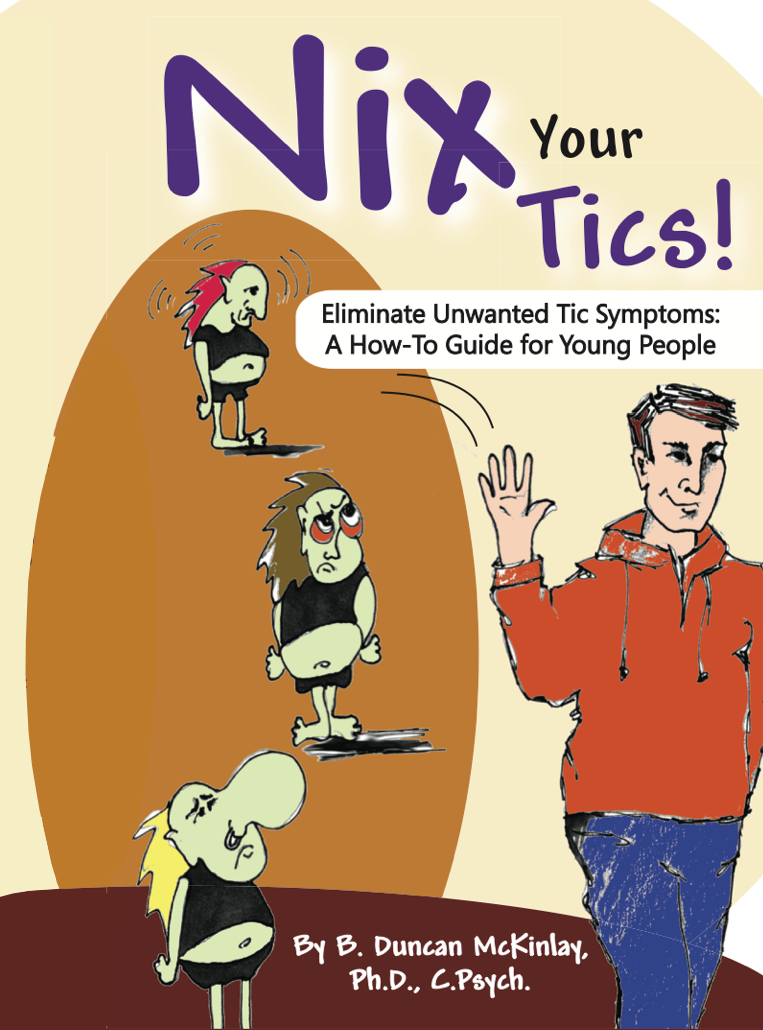
Hey. Got tics? You’re not alone. Up to one in five kids will have at least one tic at some point. Including the guy who wrote this book!Dr. B. Duncan McKinlay, Psychologist (‘Dr. Dunc’) has Tourette Syndrome. That means he’s been living with both motor tics (movements he has a hard time stopping) and phonic tics (noises he has a hard time stopping) for most of his life. He knows firsthand how annoying, embarrassing, misunderstood, painful, and disruptive tics can be. For years, he’s been educating people all around the world by means of his presentations and website, and through appearances on television, in magazines, and on film. Now, in Nix Your Tics!, he wants to share with you a well-established, evidence-based practice* he uses to manage tic symptoms in both himself and in his patients.
*as per criteria set out by the American Psychological Association’s Division 12 Task Force on Promotion and Dissemination of Psychological Procedures
*technique strongly recommended as a first-line treatment (Canadian Guidelines for the Evidence-Based Treatment of Tic Disorders)
Nix Your Tics! is a self help book written to help youth and young people learn to stop or control bothersome tics & twitches (such as those found in Tourettes) and other nervous habits. It shares management techniques, teaches evidence-based behavioral treatments (habit reversal training and CBIT), fosters a positive attitude, and provides hope.


More About The Book | Facebook Group |Twitter
All activities related to "Life's A Twitch!" and/or "Life's A Twitch! Publishing" are conducted by B. Duncan McKinlay, Ph.D., C.Psych. (Retired) in a private capacity and do not represent the Ministry of Children and Youth Services, or the Government of Ontario. All activities related to "CPRI" and/or "The Brake Shop" are conducted by B. Duncan McKinlay, Ph.D., C.Psych. (Retired) in a public capacity as an Ontario Ministry employee.d
In writing 'Nix Your Tics!', Dr. McKinlay is acting strictly in a private capacity and not as an Ontario public servant. Hence, promotion and sale of this book will not occur during Dr. McKinlay's "Brake Shop" conference appearances and presentations.
