Home
Nix Your Tics
Documentary
Writings
Youth Haven
Ask Dr. Dunc
Accolades
Presentations
Resources
Links
Disclaimer
Contact
If
you are a new visitor, diagnosed with a difference, please read this introduction
letter to you.
For
all other new visitors, Dr. McKinlay also has a
special introduction letter to you.
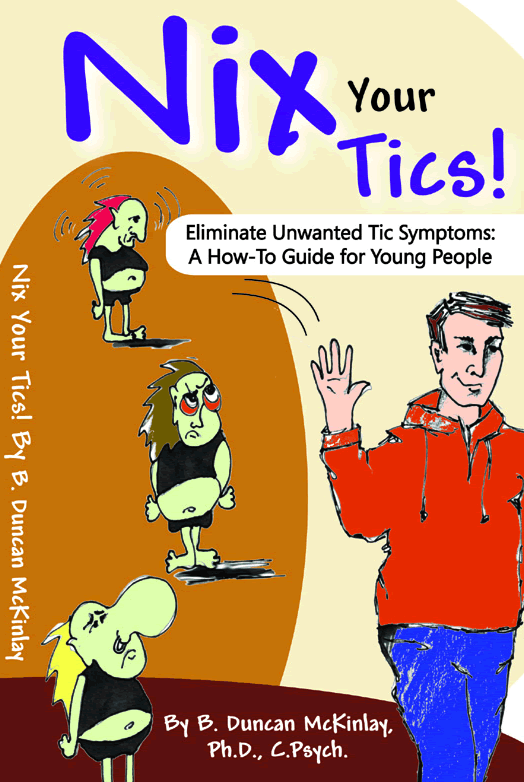
Nix Your Tics!
The Second
(E-)dition from "Life's A Twitch! Publishing". Click here to learn more.
To watch the Life's A Twitch! documentary via streaming video, click
here.
If
you would like to reprint writings from this site, please click
here.
Before
Signing the Guestbook

 
To
return to the 'Print Profiles' archive page, please click
here.
|
 |
1998 - 2018 |
|
|
|
Disability
Cornerstone To Duncan's Success
BY MICHELLE STRUTZENBERGER
FAMILY NET NEWS
www.familynet.on.ca
Monday
September 9, 2002: Duncan McKinlay says he hasn't become
a successful young person despite his disability, as many might
suppose. In fact, it has been key in helping him to become the
man he is today. "Over the years I've learned how to use
what I am to my advantage, to see the different ways that having
my disorder is an asset," says Duncan, who has Tourette's
Syndrome.
He
explains that the condition has led to his career as a doctor
of psychology. He plans to eventually own a practice that
focuses on children with Tourette's. On weekends, he crosses
the country holding workshops on Tourette's and managing a
related Web site - called Life's A Twitch.
Of
course, it hasn't been the disability itself that's just caused
all of this to happen. A huge part of it has been Duncan's attitude
towards his condition.
Before
he was actually diagnosed with Tourette's, which happened
at the age of 19, Duncan was deeply depressed and suicidal.
"It was a less of a question of if I would kill myself
and more of a question of when," he says. "I didn't
understand what was going on with myself and believed I was
basically a freak, unlovable and unwantable."
After
he realized what he was actually dealing with, which happened
after reading an Ann Landers article about someone with similar
symptoms, his self-perception started to change. "It pretty
much felt like the world had been lifted from my shoulders,"
says Duncan.
Of
course, the change didn't happen overnight. But gradually,
he learned to view himself in a whole different light. "Today
I recognize that how you live with a disability is largely
how you interpret it," says Duncan. "I no longer
see Tourette's as a death sentence - but simply as a quality
of me, no different from the fact that I have blonde hair
and blue eyes."
Tourette's
is a neurological disorder characterized by tics - involuntary,
rapid, sudden movements or vocalizations that occur repeatedly
in the same way. It is often accompanied by other conditions,
such at Attention Deficit Hyperactivity Disorder (ADHD) or obsessive-compulsive
behaviours.
The
syndrome was named in honour of the French physician Georges
Gilles de la Tourette, who wrote an article over 100 years
ago in which he described nine individuals who, since childhood,
had suffered from involuntary movements and sounds and compulsive
rituals and behaviours.
Researchers
are still theorizing about the genetics behind the syndrome.
Duncan
has just completed an internship in psychology at Bloorview
MacMillan. He is now planning to continue the intern phase
of his career with the Toronto District school board. [note
from Dr. McKinlay: this is an error. In actuality I will be
working as a Psychologist under supervision with the Toronto
District School Board].
Top
of Page |