Tuesday,
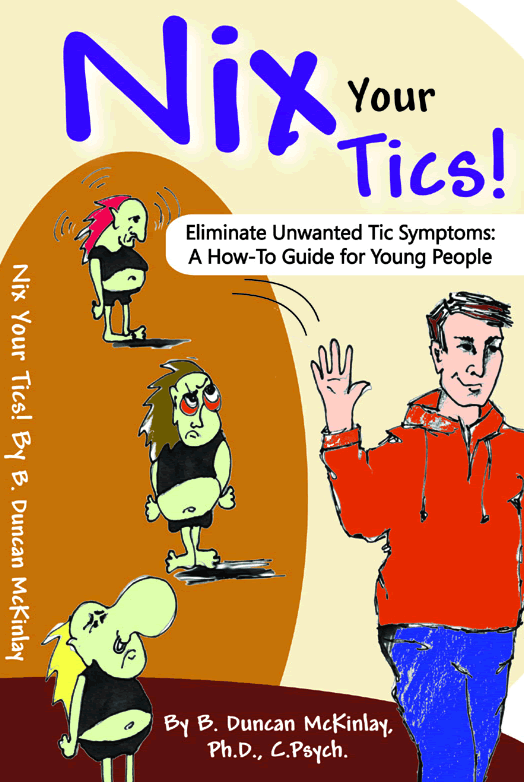
October 10, 2000: When Duncan McKinlay was growing up, he knew,
deep down, that he wasn't like everyone else. He felt as if there was
a devil in his head that hated him, and was there to watch what he was
doing.
But
McKinlay didn't know until he was 18 that he had Tourette's syndrome.
Nobody else knew either.
Tourette's
syndrome is a neurological disorder, characterized by sudden, repetitive,
involuntary movements and sounds called tics. McKinlay's symptoms include
head shaking, snorting and high-pitched barks.
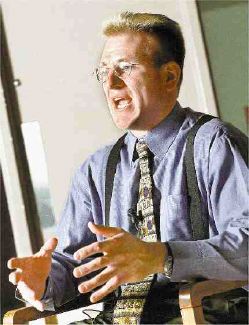
McKinlay,
26, was in Hamilton Saturday, giving a workshop to the regional chapter
of the Tourette Syndrome Foundation
of Canada. He talked about what it's like to live with the disorder,
and how to develop strategies to deal with it.
When
he was a child, his parents and teachers thought he was trying to get
attention, or deliberately annoy them. He recalled his desperate efforts
to suppress or mask his tics.
"What
are you going to think when you're seven? I'm making a weird noise,
people are laughing at me, and I will be in trouble for it -- I'll stop.
The more you think about it, the more stressed you get about it, the
worse it gets."
He
used to stand in front of a mirror and hit himself in the face every
time he had a tic. "Of course five minutes later I would be be doing
it 10 times more and I would just sink crying into the corner."
The
harder he tried, the less control he seemed to have. "I felt like I
lived in a minefield. I didn't know what I was going to step in or what
was going to blow up in my face or for how long ... I just kind of walked
through my days expecting that I was going to be in trouble."
Trying
to hold the tics in led to rage. If he let the tics out, the rage decreased.
When
he was growing up, he seemed to wreck or wear out anything he had that
was nice.
Once
he involuntarily snapped a chain that his mother gave him. Angry at
himself, he then broke it into pieces, because that was something he
could control.
"Family
didn't understand me, they were outside the wall. People at school,
they didn't understand me. I used to make so many deals with God, when
I would be crying in the corner of the bathroom ... I would say to God:
'Please, I'm sorry. Whatever I did, I take it back.'"
The
tics didn't go away, and he decided that God hated him too.
As
an adolescent, McKinlay harboured thoughts of suicide. He began to believe
he was an awful person, who should kill himself for the sake of those
he loved.
This
bright, articulate man knows what it's like to walk down the street
and see people pull their kids closer, cross the road or laugh at him.
He's heard people in stores talk openly about him, because they assume
he must be mentally challenged.
Tourette's
syndrome affects at least one person in 200. McKinlay said ignoring
having Tourette's is like ignoring an elephant in the corner.
"One
of the smartest things you can do ... is actually come clean and let
people know about your Tourette's. That's a scary thing, that takes
a lot of courage."
The
tics release energy that needs to come out in some way. "As much as
maybe you want to be just like everyone else, you're not."
He
said pretending otherwise blinds people to successful strategies.
McKinlay,
who's from the Chatham area, was 18 when he read an Ann Landers column
about Tourette's syndrome, and realized that's what he had. It was the
most pivotal moment in his life. He was officially diagnosed by a Hamilton
neurologist the following year.
McKinlay
is a McMaster University psychology graduate currently working on his
PhD at the University of Waterloo, with the goal of becoming a psychologist.
He's given his workshop, Life's a Twitch, across Canada, and is in demand
in the United States too.
Life
is much better now, but there are scars. "There are certain experiences
I can't go back and redo, now that I know what I know and have the strategies
I have. When you've grown up for 18 years without knowing what's going
on, it can ... haunt you."
Cheryl
McCarney, president of the Hamilton Region Chapter of the Tourette Syndrome
Foundation, and mother of a son with the disorder, said some parents
don't want anyone to know their child has Tourette's.
"That's
the worst thing that you can do. The more understanding, and the more
awareness of what's going on, the more the child and family are going
to be able to cope."
copyright
© 1996-2000, The Hamilton Spectator.