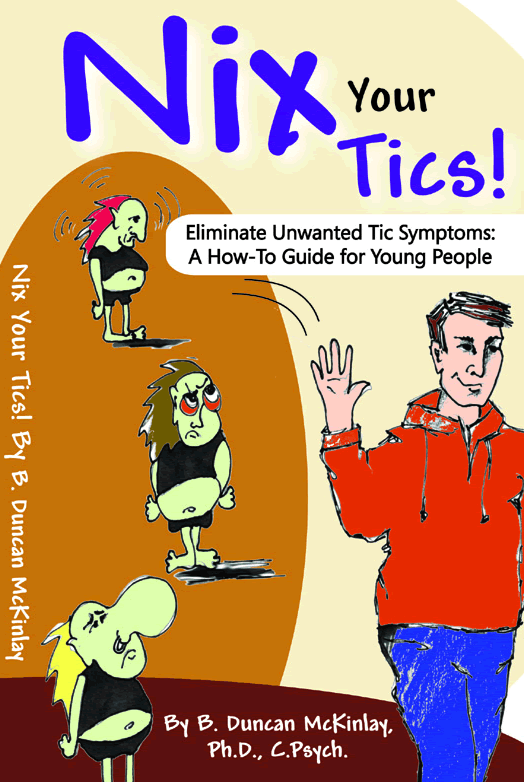
Hello:
Absolutely
it could be -- you've described many key criteria for diagnosis (motor,
phonic tics, waxing and waning to physiological, environmental and psychological
stress, and he is the typical age of symptom onset). I would recommend
either making an appointment with a psychologist, or getting your general
physician to refer you to a medical specialist for assessment. In the
meantime, I would prepare for this appointment by beginning a logbook
of what you see and when, and maybe even getting some of his symptoms
on videotape (oftentimes a phenomenon known as "Doctor's Office
Syndrome" occurs during an appointment where the child shows no
symptoms whatsoever in front of the professional. This can obviously
be quite frustrating, particularly if the professional is not well read
on the TS literature and does not realize that this is in itself somewhat
diagnostic of TS.
Good luck in this undertaking! I must commend you on your obvious attentiveness
to and concern for your son, and also for your courage to so quickly
act on what you've observed. Early diagnosis makes a tremendous difference
in the course your son's life will take -- in fact I often say that
symptoms are usually much more benign than the attitudes and reactions
TO those symptoms. I am very excited on your son's behalf -- if it turns
out he DOES have TS your quick reaction will bestow upon him the best
gifts he will ever receive. Please read an article I've written on this
topic at www.lifesatwitch.com/Ed.in.Ed.html
and accept my profound gratitude that a potential new member of the
TS family is in such good hands!
Please visit my site again should the outcome of the assessment lead
to a diagnosis of TS. I have many resources for you, and links to many,
many more.
Re:
the toy gun incident, while it is certainly something you'd want to
mention in the assessment, but my own intuition is that this incident
was either coincidental with the emergence of the first symptom or the
concern and extra scrutiny following the incident led to the notice
of some very subtle early signs of an emerging tic disorder. It is also
possible that the boy's eye WAS simply scratched, and while the blinking
WAS initially due to this discomfort this initially contextual movement
was enshrined as his first tic because of its frequency and stereotypic
presentation (as TS develops it preys on movements that occur often,
and the same way each time).
While severe head trauma can indeed cause damage to the same areas that
are responsible for TS and therefore lead to tic symptoms, and while
some individuals with TS anecdotally cite major car accidents etc. as
being catalysts for their symptoms, the neurological areas involved
in TS are subcortical (meaning they are deep brain structures). In essence
I believe it would take more of an incident than what you have described
to cause that kind of damage, and there likely would have been many
more signs of trauma than what you've seen (potentially loss of consciousness,
amnesia for the event, other losses of function or developmental deficits,
etc.). I must end by again emphasizing though that this and any other
events you think may be relevant should be revealed during the assessment
-- the more comprehensive the case history, the more accurate the diagnostic
process can be.
cheers and good luck!
Dr. Dunc.