Home
Nix Your Tics
Documentary
Writings
Youth Haven
Ask Dr. Dunc
Accolades
Presentations
Resources
Links
Disclaimer
Contact
If
you are a new visitor, diagnosed with a difference, please read this introduction
letter to you.
For
all other new visitors, Dr. McKinlay also has a
special introduction letter to you.
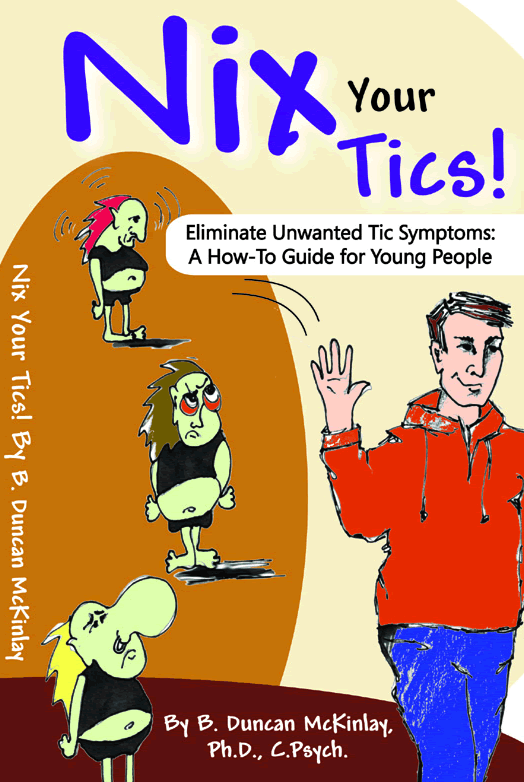
Nix Your Tics!
The Second
(E-)dition from "Life's A Twitch! Publishing". Click here to learn more.
To watch the Life's A Twitch! documentary via streaming video, click
here.
If
you would like to reprint writings from this site, please click
here.
Before
Signing the Guestbook

 
If
you wish to return to the 'Ask Dr. Dunc.' mainpage, please click
here
If
you wish to visit the 'Ask Dr. Dunc.' question archives, please
click here
|
 |
1998 - 2018 |
|
|
Question
94:
Dr. McKinlay. I have TS and am....working to establish myself
on the management speaking circuit. So, like you, I actually do quite
a bit of public and public speaking work. My
TS almost completely goes away when I am on stage or in front of an
audience talking. But as I grow my speaking career, my concern is
that I won’t be able to control my TS for prolonged periods
of time. I’m wondering how you deal with your TS when speaking
to audiences. Does it ‘manage itself’ or have you learned
certain compensatory or management strategies. G.D., ON, Canada.
Hello
back! It is always a welcome pleasure to meet another member of the
'family' who is such an excellent role model in how he chooses to live
his life! If you ever wanted to submit something to the "Role
Models" portion of my website for the next generation to read
(to learn from your successes) I would be pleased to receive it!
With regards to your comments, I wouldn't be too concerned. As of this
writing I've presented 211 times (officially) and the tics remain a
non-issue. If you consider the symptoms to be like a 'release-valve'
for your disinhibited memory, then this begins to make sense -- since
you are simultaneously engaging in high-energy tasks EVERY TIME you
speak, this will therefore constructively channel those energies every
time, and render the function of your tics irrelevant every time.
By extending this analogy, you can actually predict certain problems
and design your public speaking to thwart them. For example -- Q/A periods
will be more difficult, because you need to STOP talking long enough
to listen to the question. This tends to be when I am most likely to
tic. Hence you may wish to schedule shorter more frequent Q/A sessions
rather than a long drawn-out one. Also, you'd want to vary your speeches
-- keep them from getting automated. The less you have to work at thinking
about what you are saying, the more likely a tic urge will return. Being
passionate in what you say, moving around, etc. are all positive boons
in your line of work, and will serve the secondary function of using
up more of that disinhibited energy too.......
In closing, I'll say that probably the worst you can do is to actually
fret about it -- given the suggestible nature of the disorder, and its
tendency to prey on stress and whatever it is you are devoting your
attention to, you will create your own problems by worrying about it.
Besides, you could always 'come clean' in a Ralph Klein'ish fashion
and raise people's impressions of you while also raising the profile
of our poor misunderstood condition :)
Hope this helps sir -- take good care, and good luck to you!
Dr. Dunc.
Top
of Page |