What
used to frustrate him as a child is helping him get a master's degree
in educational psychology.
Duncan
McKinlay, now a graduate student at the University of Waterloo, was
diagnosed during his first year of university with Tourette's Syndrome
- a neurological disorder of disinhibition which affects motor function,
thought and mood. The syndrome can manifest itself through physical
and vocal tics and difficulty with impulse control which can lead to
outbursts of rage.
"You're
not doing, thinking or feeling any differently than other people do,"
explains Mr. McKinlay, "It's just that other people are very
orchestrated in what they show."
After
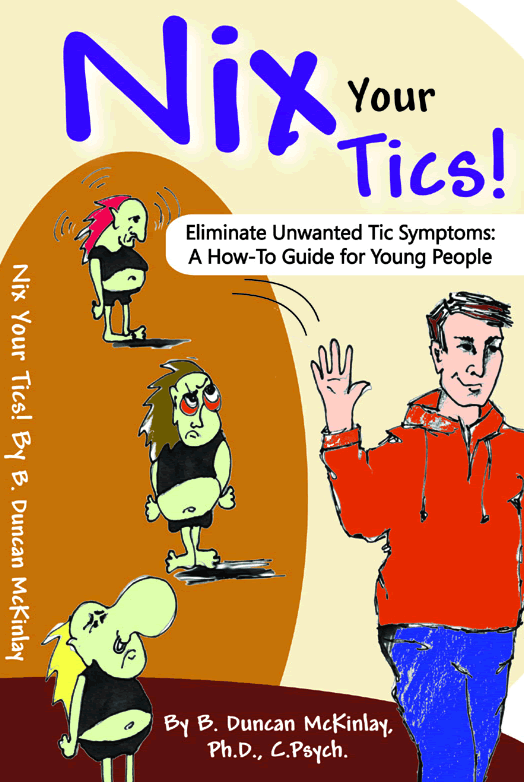
learning to cope with the disorder himself, Mr. McKinlay began working
with families of children who live with Tourette Syndrome, offering
them guidance that comes as much from personal experience as from his
academic background.
During
his undergraduate work at McMaster University, Mr. McKinlay had no intentions
of studying his own disorder.
"I
initially thought, 'No, I'm not going to work in Tourette's.
That's kind of taking advantage of the situation. If I'm
going to be a good psychologist, I should really try to understand something
completely new.'"
But
after joining an organization called Extend-A-Family and working with
a young boy who has Tourette's, Mr. McKinlay says he realized he
had something to contribute to this area of study, and felt obligated
to do so. His professors at UW supported the decision because
of his ability to empathize with children who live with Tourette Syndrome.
His
work focuses primarily on how these children perceive themselves, and
how their attitudes toward the disorder are affected by their parents'
attitudes. He is most interested in the children's self-esteem
and sense of control.
Mr.
McKinlay says he sees two very different attitudes toward Tourette's
among parents. Some parents believe nothing can be done about
the disorder. He says the most unfortunate thing for the children
in these cases is that they aren't given the chance to test the
limits of their self-control. The fact that he lives and works
successfully with Tourette Syndrome doesn't make a lot of difference
to these parents, he says.
"Typically,
their response to me is, 'You've been lucky. You don't
have Tourette's as bad as my son or daughter does.'"
But Mr. McKinlay says if he doesn't get enough sleep or is stressed
out, he is just as prone to rages as any child with the disorder.
"The difference is, I've learned to anticipate and to avoid."
His
insight into coping with the disorder is well-received by the other
type of parent, who believes that the severity of their child's
disorder can be influenced. "There's some that
really respond well to me as sort of a role model - a 'see what
my son or daughter can become' sort of thing," he says.
"They really milk me for strategies."
Mr.
McKinlay plans to continue his studies and become a clinical psychologist
specializing in Tourette Syndrome.